March Digest: Women’s History Month
From established scholars to emerging researchers, this month’s digest celebrates the work of those reshaping how we understand women’s roles in conflict and the uniformed public services.

March marks Women’s History Month, offering an important moment to reflect not only on the histories we tell, but also on those that remain overlooked, marginalised, or incomplete. Across this month’s digest, a clear thread emerges: women have always been present in the histories of war, security, and the uniformed public services - but their contributions have not always been fully recognised or understood.
From Dr Hannah West’s reflections on the inaugural CEEUPS symposium, to our conversations with leading scholars such as Juliette Pattinson, and the work of emerging researchers featured in our Spotlights section, this edition highlights the importance of visibility, representation, and critical engagement with the past.
At the same time, our “Inspiring Women” section reminds us that academic fields are shaped not only by ideas, but by the individuals who advance them—through research, mentorship, and leadership.
We hope this month’s digest offers both reflection and inspiration, and we look forward to continuing these conversations with our community.
Dr Tegan Lily Harrison
Editor, Defence Research Network
Theme of the Month: Women's History Month
Community reflections on women in uniformed services
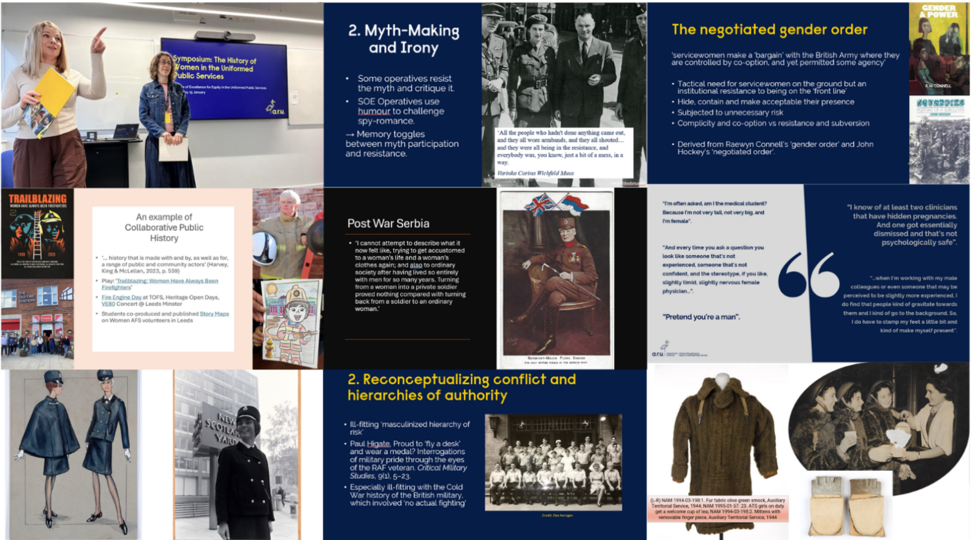
Inaugural Symposium: The History of Women in the Uniformed Public Services
In this month’s feature, Dr Hannah West reflects on the inaugural symposium hosted by the Centre of Excellence for Equity in the Uniformed Public Services (CEEUPS), which brought together historians and researchers to rethink how women are represented across military, emergency, and civil services.
Spanning topics from the Roman Army to Cold War intelligence, the symposium explored how women’s contributions have been overlooked, misrepresented, or constrained by institutional narratives. Central themes included the role of uniform in shaping identity, the persistence of gendered cultures, and the importance of intersectional histories in understanding service and conflict.
This piece highlights an emerging research community committed to making women’s histories more visible, accurate, and inclusive.
 Hannah West
Inspiring Women
As part of Women’s History Month, we reflect on scholars and practitioners who have shaped both our field and our personal journeys.
Martha Crenshaw is widely recognised as a foundational figure in terrorism studies, whose work continues to shape academic and policy debates on political violence.
We also remember Nicola T. Fear, an internationally respected scholar whose research transformed understanding of military health and wellbeing, and whose legacy includes championing early career researchers.
Finally, Dany Cotton stands out as a pioneering leader in the fire service, whose career reflects both the progress made and the challenges that remain for women in uniformed roles.
 Hannah West
In Conversation
Professor Juliette Pattinson
Prof Juliette Pattinson
We sat down with Juliette Pattinson to discuss her academic journey, from early inspirations to becoming Professor of War Studies at King’s College London.
Reflecting on the influence of mentors, the role of chance in shaping careers, and her continued engagement with women’s experiences in conflict, she offers valuable insights into research, teaching, and the evolving study of war and society.
From interviewing Second World War operatives to engaging with interdisciplinary IR scholarship, this conversation highlights both the depth and breadth of her work.
 Hannah West
Spotlights: Meet the Historians
This month, we highlight emerging scholars whose work is reshaping how we understand women, conflict, and military history.
Sophy Higgins (King’s College London) explores how class shaped women’s access to aviation in interwar Britain, working closely with museum archives to uncover overlooked histories.
Ashleigh Percival-Borley (Durham University) examines the cultural afterlives of the Special Operations Executive, analysing how gender, memory, and identity are constructed through oral histories and public narratives.
Together, their work demonstrates the importance of archives, heritage, and public engagement in challenging dominant histories of conflict.
 Hannah West
What We’ve Been Listening To
March 2026
This month’s playlist explores war through lived experience, resistance, and strategic analysis - from the realities of combat to the dynamics of contemporary conflict and military coordination.
War on the Rocks | What It Was Like to Be Under Incoming Fire
A powerful reflection on the lived experience of combat, tracing how being under fire shapes perception, decision-making, and memory from the War on Terror to today. This episode connects personal testimony with broader military realities.
UkraineWorld | Why Ukraine’s Resistance Starts with Ordinary People
This episode explores how resistance in Ukraine is rooted not only in military capability but in the everyday actions and resolve of civilians. It introduces the idea of a “human spirit radar” as central to national resilience.
RUSI Global Security Briefing | The US-Led Attack on Iran
An expert-led discussion unpacking the regional and global implications of the US-led strike on Iran, with a focus on escalation dynamics, deterrence, and shifting geopolitical alignments.
RUSI Talking Strategy | Force Integration in 1940: Dowding’s Air Defence System
This episode revisits the development of RAF Fighter Command’s integrated air defence system during the Battle of Britain, offering insights into coordination, technology, and enduring lessons for modern warfare.
You can find links to all podcast episodes in our post.
 Veronika Hinman
What We’re Reading
March 2026
Recent publications continue to unpack the global significance of the war in Ukraine and its implications for international politics.
The War in Ukraine and the Changing World Order – Stipe Buzar & Jean-François Caron
This edited volume examines the war in Ukraine as a turning point in global politics. Bringing together interdisciplinary perspectives, it explores the nature of the Russian regime, Western responses, and the shift towards a more contested, multipolar international order.
International Politics and the Russo-Ukrainian War: Concepts in Conflict – Jonathan Paquin & Alexander Lanoszka
This book uses the invasion of Ukraine as a framework to explore ten core concepts in International Relations. Each chapter connects theory to practice, offering a structured and concept-driven approach to understanding contemporary conflict.
Find out more and access links to both books in our post.
 Veronika Hinman
Get involved with the DRN
Get in touch
We hope you've enjoyed our news, tips and recommendations. In case you missed our previous newsletter editions, check out our archive section here. Over the coming months we'll be transferring our past content to the new website.
We're always looking to showcase early-career researchers in research and their work, so don't be shy in getting in touch, and we welcome any suggestions for 'In Conversation' pieces with more established academics. And don't forget to let us know about any events you, or your departments, schools and Universities might be hosting in the near future, from book launches to webinars.