Canadian Institute for Military and Veteran Health Research (CIMVHR) Forum 2025 – Reflections from a postdoc
In this post, Dr Lucy Robinson reflects on her recent attendance at CIMVHR Forum 2025, from her perspective as a postdoc.
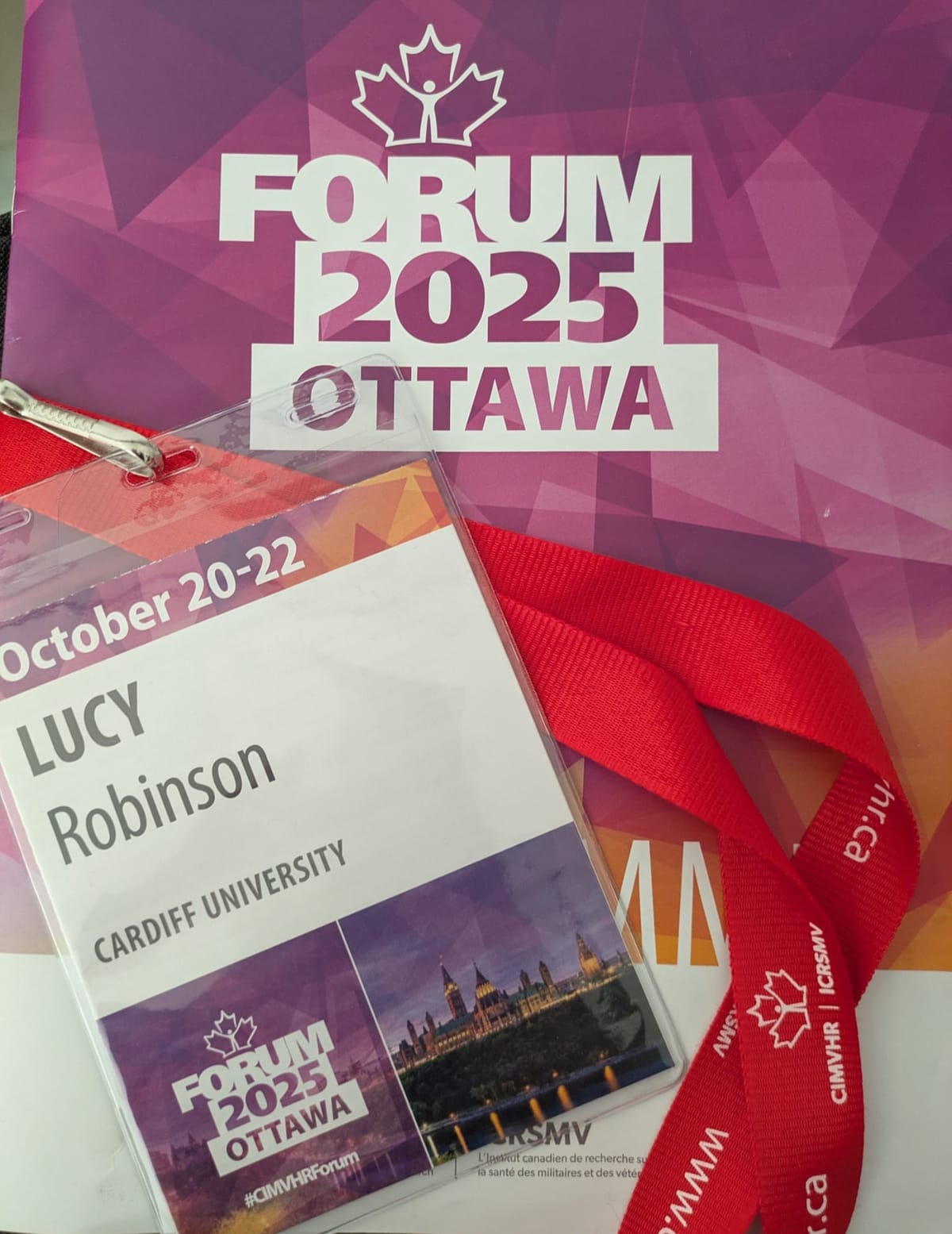
As part of my Economic and Social Research Council (ESRC) Postdoctoral Fellowship, I was fortunate enough to attend CIMVHR Forum 2025. Held this year in Ottawa, it was the 15th year of the event which “serves as a platform for thought leaders across various sectors to exchange insights, collaborate, and showcase advancements in research and ideas for the betterment of our military personnel, veterans and their families” (CIMVHR, 2025). Spanning three days, the conference agenda was packed with posters, presentations and workshops alongside numerous networking opportunities.
The Forum kicked off with the 2025 CIMVHR-Garnet Families Roundtable. Garnet Families are those connected to military, defence, first responder and public safety sectors who navigate four unique lifestyle dimensions – risk, identities, mobility and logistics. The symbol of the garnet was chosen for the relevance of its symbolism – love, loyalty and safe return to family – to these families. The team behind the Garnet Families Partnership opened by providing a high-level overview of how these families have been conceptualised over time; from being classified under ‘furniture & effects’ to the creation of the Garnet Families Partnership. The Partnership, a formal collaboration funded by the Social Sciences and Humanities Research Council (SSHRC), “brings together dozens of relevant parties across Canada and internationally to collectively set priorities for research, create knowledge, and enhance our research capacity to optimize individual and collective family well-being" (Garnet Families, 2025).
The presentations, running concurrently in blocks of five, covered a diverse range of topics broadly defined under ‘health and wellbeing’ and included work on brain health, military sexual trauma, military culture, transition and retirement, and operational wellness - to name but a few! Over the three days, I attended streams focused on topics such as identity and social support for veterans alongside those more closely aligned to my research specialism of service children. This included five presentations grouped under the title ‘for the families with the families’ which were united by their use of authentic co-production. A particular standout was the presentation delivered by the Australian academic Dr Amy Johnson on her work with Dr Marg Rogers; ‘Supporting children with family mobility: International co-created knowledge translation storybook project’. Their co-designed and evidence-based resources – including a range of storybooks and multimedia resources - are freely available for children, families and service providers to use. Indeed, twelve children’s storybooks are currently in the process of being adapted to be culturally appropriate for Canadian military, veteran and public safety personnel (PSP)/first responder families.
On the second day, I had the pleasure of presenting my work ‘The ‘service child identity’: An alternative conceptualisation for understanding how service children see themselves and understand their lives as members of the armed forces community’. In my talk, I spoke about how this key output of my doctoral work – the ‘service child identity’ – offers both researchers and practitioners a more nuanced understanding of how service children see themselves; going beyond the often static, passive and homogenising discourses of deficit or strength models. I felt privileged to share my work with such an engaged audience and felt gratified to find that my conceptualisation resonated amongst my predominately Canadian audience.
I had the pleasure of presenting alongside five other individuals, both researchers and service providers, grouped under the stream titled ‘supporting children throughout the life course of service’. This included an excellent presentation delivered by PhD candidate Isabella Thomas looking comparatively between Canadian young people with and without a parent or guardian in the Canadian Armed Forces using the Health Behaviour in School-aged Children (HBSC) study data.
It was a privilege to hear from, meet and engage with a range of researchers and service providers in a shared space. I particularly welcomed the opportunity to hear cross-cultural perspectives and gain knowledge and understanding of complementary research happening in the Australian and Canadian contexts. From a broader military families perspective, I was gladdened to see that there was a dedicated ‘families’ stream across each of the days alongside the 2025 CIMVHR-Garnet Families Roundtable. I also took the opportunity to attend sessions which, whilst outside of my research specialism, complemented my existing interests and offered me insights into current military research more broadly.
As both a first-time attendee of Forum and an early career researcher (ECR), I felt very welcome. CIMVHR’s Student and Postdoctoral Engagement Community (SPEC) ran two events – a welcoming community networking event on the first night and a later morning workshop focusing on self-care – both designed to support and promote connection and community for early career researchers. They also organised a table one could freely join at lunch; helping to make the conference feel that little bit less daunting and more personable for students and postdocs alike. My gratitude goes both to the SPEC team and the wider CIMVHR team for their months of hard work and effort in organising and delivering FORUM 2025.
Dr Lucy Robinson
Lucy is an Economic and Social Research (ESRC) Postdoctoral Fellow at Cardiff University. Her one year fellowship aims to consolidate her recently completed ESRC-funded DPhil at the Department of Education, University of Oxford. Her doctoral research involved working creatively with groups of service children to explore how military life shapes their identity and school experiences. Lucy is a longstanding committee member of the DRN and is currently the Social Media Co-manager.